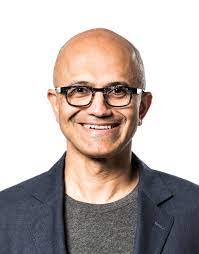
Satya Nadella

Satya Nadella

Chairman and CEO at Microsoft
Company Tenure: 31 years
Education:
Manipal Institute of Technology (B.S.) University of Wisconsin–Milwaukee (Graduate) University of Chicago (M.B.A.)
Biography:

Satya Nadella, serving as a Board Member at Starbucks for the past 7 years, brings a wealth of experience primarily shaped by notable roles at Sun Microsystems and Microsoft, amassing an impressive 31 years in the tech industry. Holding a B.S. in Electrical Engineering from the Manipal Institute of Technology, a Master’s in Computer Science from the University of Wisconsin-Milwaukee, and an MBA from the University of Chicago, Nadella’s educational background underscores the depth of their expertise.

Beyond the boardroom, Nadella is actively involved in academic and philanthropic spheres. Their affiliation with the University of Chicago and engagement with organizations like The Business Council U.S. and the Fred Hutchinson Cancer Center reflect a commitment to education, business, and healthcare. Additionally, Nadella has made significant financial contributions, with donations of $10,000 to Republican related causes and $13,400 to Democrat related causes.

Profile Details

Total Political Contributions More information

Republican Support
Democratic Support
$10,000 $13,400

Affiliated Companies

Key Statements

“But I don't want us to be only talking about high skilled immigration because there's one other quality that United States has which is real currency in the world. It's that being that bastion of hope for all people who need it most. I think both of those need to be preserved. And any immigration policy that we come up with should really keep those front and center because that to me, is what makes not only America unique, but also gives us the competitive power.”

“We definitely are subject to the laws of the land. But at the same time we will move the courts to make sure that the people who work at Microsoft, who are dreamers, get all the support they can from us so that they can continue to contribute not only to Microsoft, but to the United States.”

"And so I think I learned a very deep lesson that one's own personal experience sometimes can be an unconscious bias and especially writ large at a society level. And so I got to work on what I needed to work on, which is to work on what are we doing at Microsoft for gender diversity? What are we doing at Microsoft for ethnic diversity?"

“We are very, very clear at Microsoft that we will support the women's choice on their rights, on any medical decisions they make. And so therefore our insurance will cover them wherever they want to go and exercise that right. So we will make sure we do protect our employees.”

“But if I think about even some of the issues we talked about around equity or the rise of inequity we do need in our social democracies or our capitalist societies to deal with some of the dystopian views that Marx had of late stage capitalism. I think rereading that is not a bad idea because I think capitalism’s only stable ground we have is if there is increasing levels of equity for more people…I'm definitely a capitalist, I run Microsoft, but my father's Marxist leanings at least get me to think about what are the virtues of capitalism that we need to make sure we preserve and not be blinded by.”

“For us, the business case for diversity is just very straightforward. If you go back again to our mission and say, we want to empower every person and every organization on the planet, you've got to represent that planet with its full richness and diversity in the company. There is no way we can do a good job of building the products that we aspire to. And I think about, very broadly, diversity. That means it's about gender. It is about ethnicity. It is about the LGBT community feeling like they can do their best work at Microsoft. It's the entire spectrum.”