
Following a year of research, corporate engagement, coalition building, and public accountability, major corporations have started to abandon SPLC-based charitable gift matching restrictions, charitable-giving processors have changed their practices, and hundreds of companies have faced calls for reform.
October 17 marks one year of 1792 Exchange’s campaign to end corporate reliance on the Southern Poverty Law Center’s (SPLC) controversial “Hate List” to determine which nonprofit organizations are eligible for employee charitable giving and corporate matching programs.
Working alongside Bowyer Research, Inspire Investing, The Heritage Foundation, Alliance Defending Freedom, and other coalition partners, 1792 Exchange has helped secure meaningful policy changes at major American corporations, raised national awareness of discriminatory charitable-giving practices, and pressed major charitable giving processors and hundreds of companies to review their reliance on the SPLC’s “Hate List” data.
The campaign began with original research by 1792 Exchange into Benevity, one of the nation’s largest corporate charitable-giving platforms, which processes billions of dollars in donations annually. The research helped uncover how Benevity uses SPLC designations to exclude mainstream conservative, Christian, pro-family, and other advocacy organizations from corporate charitable gift matching programs, often without employees or corporate leadership understanding the criteria behind those restrictions.
1792 Exchange identified more than 200 Fortune 1000 companies with verified Benevity giving portals, highlighting the scale of the potential problem and creating a foundation for shareholder engagement, direct corporate outreach, coalition advocacy, and investigative reporting.
Here is a recap of all the major accomplishments and developments over the past year:
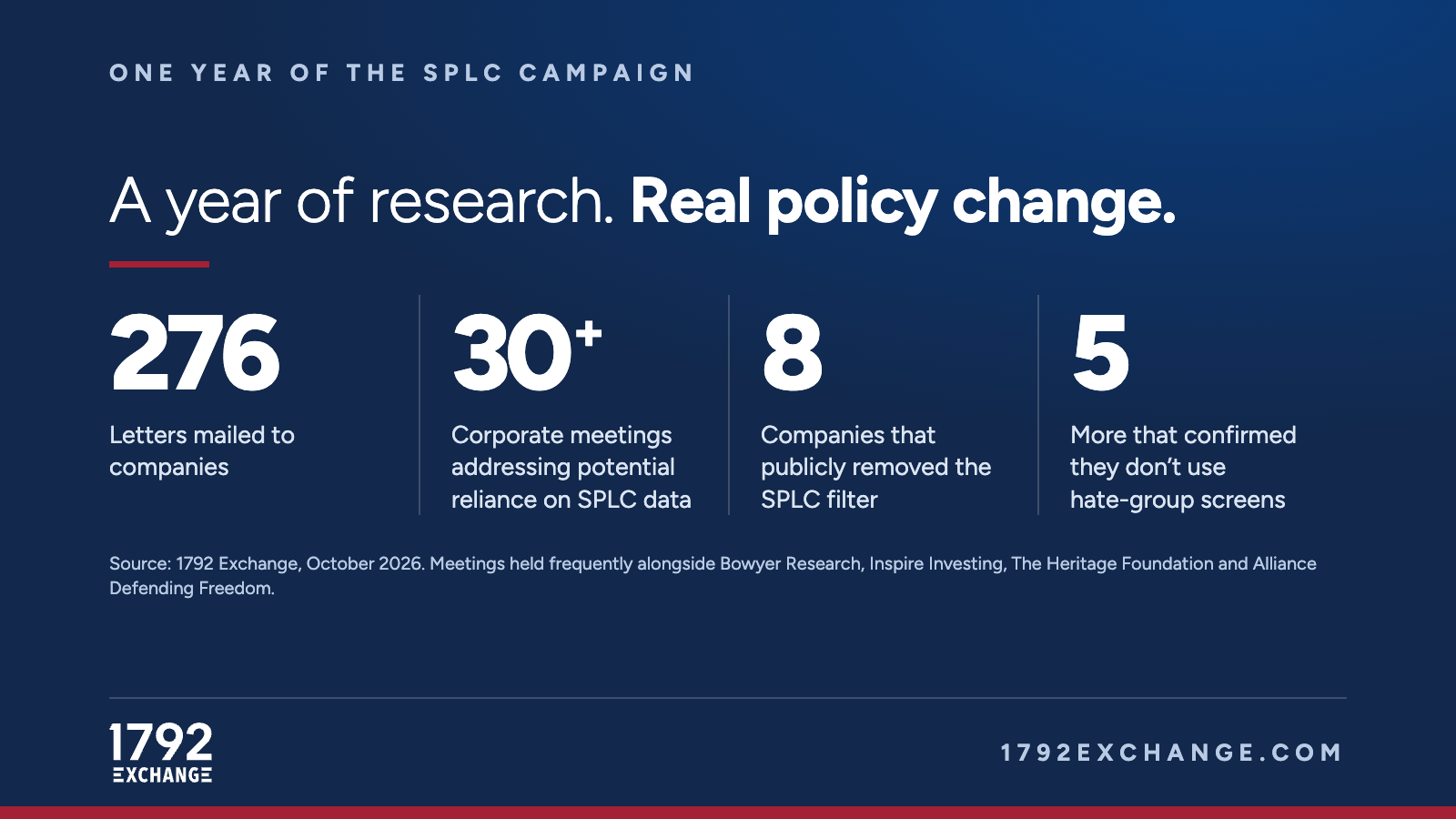
Major Accomplishments Over the Past Year
Eight Major Corporations Publicly Removed the SPLC Filter
Through shareholder engagement, research, and public accountability efforts by 1792 Exchange and coalition partners, eight major corporations have publicly removed the SPLC filter from their charitable-giving programs, including:
- Salesforce
- Mastercard
- Texas Instruments
- AT&T
- NVIDIA
- Microsoft
- American Express
- DoorDash
Five additional companies have publicly confirmed that they do not use politicized hate-group screening to determine charitable eligibility.
- This includes Meta, Morgan Stanley, Citi, McDonald’s, and Philip Morris.
Five major corporations have publicly distanced themselves from the SPLC.
- This includes Alphabet, Mastercard, Meta, PayPal, and Salesforce.
30+ Companies Directly Briefed on the Issue
- Over the past year, 1792 Exchange participated in 30+ corporate meetings addressing potential corporate reliance on SPLC data, frequently alongside Bowyer Research, Inspire Investing, The Heritage Foundation, and Alliance Defending Freedom.
- Companies engaged on the issue include Salesforce, AmEx, Mastercard, McDonald’s, and Texas Instruments.
275+ Companies Engaged on the Issue
- 276 letters mailed to companies identified as having made direct donations to the SPLC since 2020 and/or using Benevity giving portals.
Corporate Charitable-Giving Processors Began Changing Their Practices
- Groundswell, a corporate charitable-giving platform, confirmed that it no longer automatically excludes organizations appearing on the SPLC’s Hate List. Although Groundswell said the policy change occurred in 2024, its website continued to reference SPLC-based restrictions as recently as December 2025. Those references have since been removed.
- Millie Giving, another charitable-giving platform, removed website language stating that its nonprofit screening relied on the SPLC following public scrutiny of the practice.
- While it has not yet publicly committed to removing SPLC-based screening from its platform entirely, Benevity has deactivated the SPLC’s charitable-giving profile, preventing donations to the organization through that profile.
- Benevity has also deleted public references to the SPLC from its website and, allegedly, asked the WayBack Machine to remove these links as well following a Washington Post report.
Built a National Coalition of Organizations Unfairly Placed on the SPLC’s Hate List
- This includes Alliance Defending Freedom, American Family Association, Center for Christian Virtue, David Horowitz Freedom Center, Defending Education, Do No Harm, Family Policy Alliance, Family Research Council, Focus on the Family, GenSpect, Moms for Liberty, Partners for Ethical Care, PragerU, Them Before Us, and Turning Point USA.
Original 1792 Research Fueled National Media Coverage and Congressional Scrutiny
- Original research exposing Benevity’s reliance on SPLC designations and identifying hundreds of corporate Benevity portals informed reporting by the Daily Caller, The Daily Signal, The Daily Wire, National Review, The Hill, The Washington Post.
- This research received additional attention during a June 2026 House Judiciary Committee hearing examining the SPLC.
- 1792 Exchange also brought the issue to broader audiences through television, podcasts, financial industry presentations, and an October 2026 appearance on Timcast IRL.
Created New Corporate Accountability Tools to Sustain Reform
- To make the campaign’s findings accessible and sustain pressure for reform, 1792 Exchange launched a Benevity Hub with resources outlining the SPLC’s controversial nature and Benevity’s historical reliance on SPLC, compiled corporate donation records to the SPLC, and a webpage How Companies Have Responded to the SPLC tracking how hundreds of major companies have responded to the growing concerns surrounding the SPLC.
The Work Continues
Although significant progress has been made, the campaign is far from complete.
Over 200 companies with identified Benevity portals have yet to publicly clarify whether their programs rely on SPLC designations. Meanwhile, Benevity has yet to publicly commit to removing the SPLC filter from its platform entirely.
1792 Exchange will continue working alongside coalition partners to engage corporations and charitable-giving processors, encourage the disclosure of existing screening practices, and promote objective, viewpoint-neutral standards for charitable eligibility.
“Over the past year, our research and corporate engagement have helped produce meaningful changes at some of America’s largest companies. We are grateful to our coalition partners and to the companies and charitable processors that have addressed these concerns. But the work is not finished. It is time for the remaining companies to publicly address this issue and for Benevity to remove the SPLC filter from its portal entirely.”
Douglas Napier, Executive Chairman and CEO of 1792 Exchange
For more information about the campaign and how individual companies have responded, visit: https://1792exchange.com/1792-insights/how-companies-have-responded-to-the-splc/