Human Rights Campaign
Links, resources, and documents related to the Human Rights Campaign (HRC) and their Corporate Equality Index (CEI)..
From the Content Hub
-
Mount Sinai Backs Down. Will Corporate America?
The writing is on the wall for gender ideology and corporate America should respond. Its authorities are discredited, its sciences unfounded, and its public support dwindling — not to mention the very providers who push sex-denying procedures on minors are now being held accountable for the experiment they’ve been running. Mount Sinai Health System is… read more
-
The DOJ Is Suing Over Secret “Gender Transitions” in Schools. The HRCF and Its Corporate Backers Helped Pave the Way
The Human Rights Campaign Foundation (HRCF) has spent years pushing gender ideology into our nation’s K-12 schools through its Welcoming Schools initiative. Marketed under the guise of “bullying prevention,” this HRCF flagship program supplies LGBTQ+ resources and trainings to educators and school boards. According to the HRCF’s 2026 Annual Report, more than 30,000 educators participated in Welcoming Schools training last year. Given the program’s unparalleled reach, it… read more
-
Companies Reviewing GLP-1 Coverage Should Also Review Transgender Healthcare Coverage
According to reports earlier this month, Starbucks is ending GLP-1 coverage for its employees. Under its new healthcare plan, Starbucks will no longer cover prescription drugs used for weight loss, but it will continue to cover comprehensive transgender healthcare interventions, including reconstructive surgical procedures and puberty blockers, for covered dependents. Employers are pulling back on GLP-1… read more
-
HRC Launches Educators for Equality Pledge
As a new school year rolls around, the Human Rights Campaign (HRC) launched a new pledge focused on recruiting educators to commit to “ensure every student feels safe, valued, and affirmed.” This Educators for Equality pledge, among other things, asks signatories to: This initiative fits squarely within HRC’s existing work in schools via its Welcoming Schools program, an “anti-bullying” curriculum that functions as a subversive way to discuss LGBTQ+ topics in the classroom. If that accusation… read more
-
HRC National Dinner Sponsorships Plummet 54.5%
The Human Rights Campaign is currently recruiting sponsors for its 2026 National Dinner, and its sponsorship materials provide a revealing comparison. Because these advertisements list sponsors from the previous year, 1792 Exchange was able to compare the 2024 and 2025 National Dinner sponsor rosters. The result: HRC National Dinner sponsorships have declined by 54.5%. This sharp decrease… read more
-
1792 Exchange applauds the meaningful progress at Charles Schwab
Inspire Investing deserves strong credit for years of dedicated corporate engagement and a broader commitment to policies that advance human dignity, viewpoint diversity, and long-term shareholder value. Inspire began engaging Schwab in 2023, constructively raising key issues around political neutrality, employee benefits, and workplace culture. Their persistence helped bring these matters forward and supported productive,… read more
Infographics

Documents
-
HRC’s Bias in Political Endorsements
-
550+ Companies Covering Sex-Denying Procedures for Minor Dependents
-
Risks Associated with HRC Foundation Partnership
-
Risks Associated with HRC Corporate Partnership
-
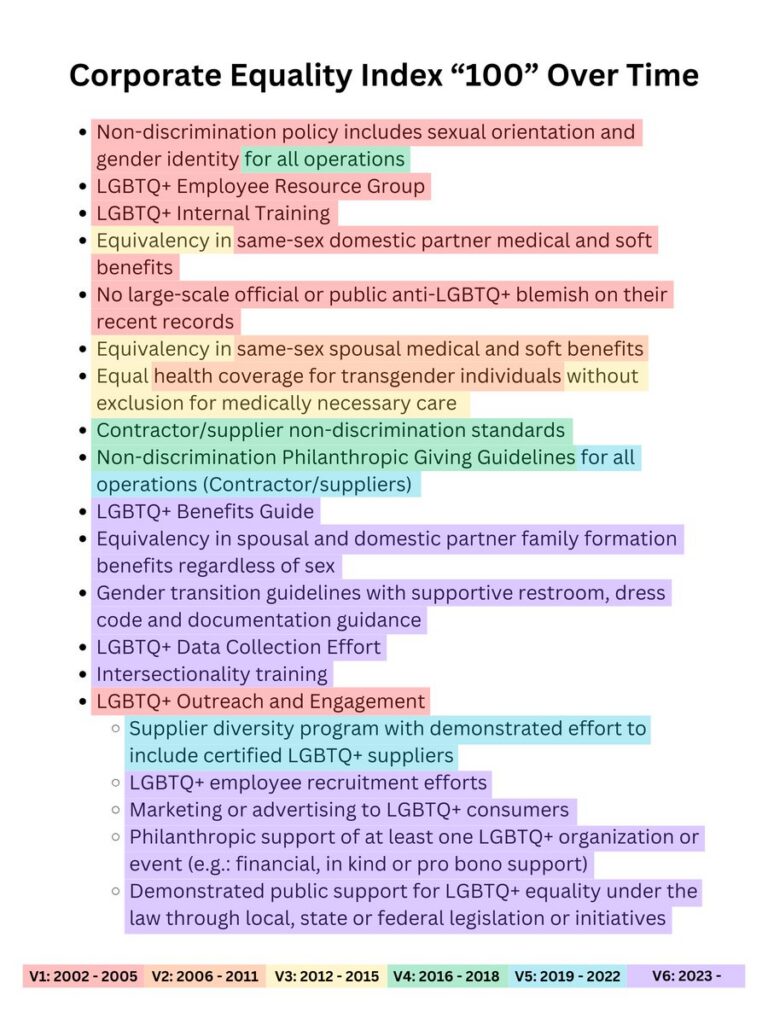
The Full CEI Equality 100 List
-
2026 Human Rights Campaign’s Corporate Equality Index 100 Publicly Traded List
-
To Corporate America: Add a Carve-Out to Protect Kids
The Human Rights Campaign is the largest LGBTQ advocacy organization in the United States. While the name sounds innocuous, HRC operates as an activist group that works to reshape corporate America’s policies and practices around progressive gender ideology. Its primary tool for influencing companies is the Corporate Equality Index, administered by the Human Rights Campaign Foundation (HRCF).
The CEI is HRC’s annual scorecard that rates major U.S. companies on their alignment with HRC’s policy demands. Companies submit their internal policies for grading through an HRC portal, and a score of 100 signals full compliance with HRC’s agenda. In practice, the index functions less like a voluntary survey and more like a social credit system, rewarding companies that adopt HRC’s preferred positions and pressuring those that do not.
The Corporate Equality Index (CEI) pushes corporations to prioritize progressive activism over its core business and ahead of its shareholders, customers, and employees. Furthermore, its requirements cause real harm. Most notably, the CEI has pressured companies into covering gender transition drugs and surgeries for the minor dependents of employees. Corporations should not be funding experimental medical procedures on children through family health plans. Companies serve everyone best when they focus on business.
1792 Exchange’s research identifies several distinct risks for companies that sponsor HRC or the HRC Foundation.
Partisan alignment
HRC is a 501(c)(4) whose endorsements and affiliated PAC overwhelmingly back Democratic candidates, so corporate support can be read as political side-taking, especially when it is not balanced by comparable support for organizations promoting conservative or traditional values.
Controversial policy advocacy
HRC’s positions extend well beyond traditional nondiscrimination into highly contested debates over transgender healthcare, sports participation, and access to sex-based facilities.
Reputational and stakeholder risk
Activist campaigns, shareholder criticism, and media coverage tie sponsors to HRC’s positions. As seen with Bud Light and Target, association with contested initiatives can contribute to sales declines, brand damage, and consumer backlash.
Governance and confidentiality risk
Participation in the CEI requires companies to submit non-public information for outside review, which lets an external advocacy organization influence internal governance decisions.
Legal and regulatory risk
Recent executive orders and Department of Justice guidance addressing DEI and unlawful discrimination have raised the stakes, particularly for federal contractors. HRC’s own 2026 report acknowledged that many companies leaving the CEI are federal contractors.
Market and peer risk
Participation is falling fast, so continued involvement increasingly positions a company as an outlier and invites greater scrutiny from shareholders.
Three things: drop activist scorecards like the CEI, institute clear protections for minors in employee health plans, and adopt durable policies that keep the company neutral on ideological issues. Charles Schwab and Walmart have already established explicit carve-outs prohibiting coverage of gender-transition interventions for minors, proving that if the world’s largest private employer can do it, any company can. 1792 Exchange can equip companies with model language others have used to update their policies.
1792 Exchange maintains public databases, including our Corporate Bias Ratings and the Back to Business Tracker, which catalog corporate policies and document the concrete changes companies have made to get out of divisive social and political issues and back to business.
Related Content
-
Corporate stewardship, the cost of ideological activism, and the trust that built America.
-
The Companies That Left HRC’s Index Are Still Sponsoring Gender Ideology
-
Inspire Investing Maps the Four-Year Reversal on Gender-Transition Care for Minors
-
Gender Surgery for Minors Faces a Legal Reckoning
-
Schwab and Walmart get it right on not covering “gender transitions” for minors
-
Professionals Are Betting Less on Identity Politics for Career Advancement
-
Doug Napier on Getting Corporate America Back to Business
-
Is Corporate America Hostile Toward Christians?
-
Activist Groups Push Companies to Cover “Transitions” for Minors
-
Greg Scott on the SPLC, the HRC, and Corporate America’s War on Children